
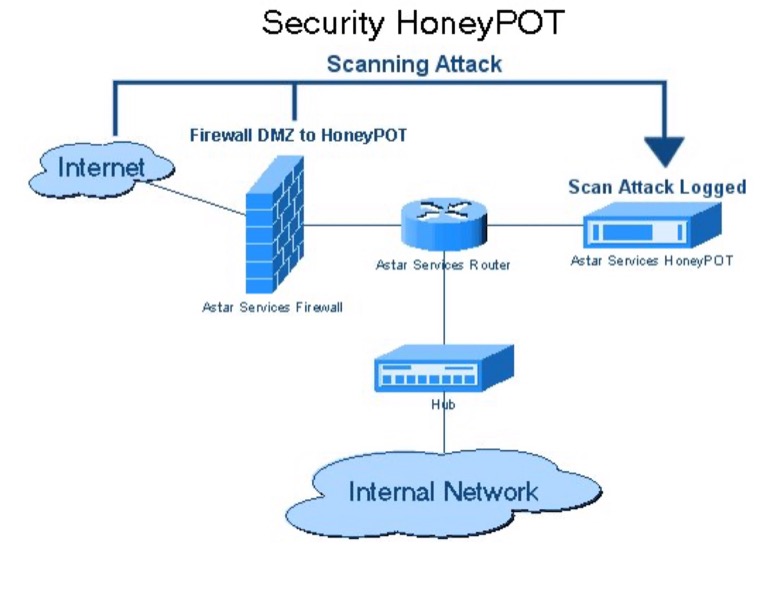
Summary. Honeypots have been used for decades to learn about attackers. Turning them into a production defence raises ten practical challenges, from realism and placement to maintenance and measurement. Each one has a workable answer.
A Short History
The idea of luring an intruder with fake assets is older than the word honeypot. In the mid-1980s, astronomer Clifford Stoll, tracking a hacker in the computers of Lawrence Berkeley National Laboratory, created a set of convincing but fictitious files to keep the intruder connected long enough to trace the calls. He told the story in his 1989 book The Cuckoo's Egg. In 1999 the Honeynet Project was founded to study attackers with networks of research honeypots, and through the 2000s honeypots became a standard research tool. Commercial deception platforms followed in the 2010s, aiming to bring the technique into everyday corporate defence.
Research Honeypots versus Production Decoys
A research honeypot is usually exposed to the internet to collect information about attacks in the wild: which exploits are being used, which passwords are tried, which malware is dropped. A production decoy sits inside a corporate network with a different purpose: to detect and slow down attackers who are already in. That shift brings new challenges.
Ten Challenges and How to Meet Them
- Realism. Decoys that look obviously fake will be ignored. They should match the naming conventions, operating systems and services of the surrounding network.
- Fingerprinting. Skilled attackers check for tell-tale signs of emulation. High-interaction decoys running real software are harder to spot than simple emulators.
- Placement. Decoys must sit where attackers will look: in every major network segment, near high-value systems and on the paths that stolen credentials lead to.
- Lures. A decoy nobody finds catches nobody. Breadcrumbs on real endpoints, such as credentials and saved connections, guide intruders towards the traps.
- Containment. A high-interaction decoy must never become a launch pad. Outbound connections from decoys should be blocked or tightly controlled.
- Maintenance. Networks change constantly. Decoys need to be refreshed so they continue to look like part of the environment.
- Noise from your own tools. Vulnerability scanners, inventory tools and administrators will touch decoys. Exclude known sources so alerts stay meaningful.
- Integration. Alerts must reach the people and systems that can act on them, usually through the SIEM and incident response tooling.
- Legal and policy review. Monitoring and data collection inside decoys should be reviewed against internal policies and local law. Decoys are defensive: they observe and delay, they never attack back.
- Measuring value. Track detections, the time from intrusion to alert and the results of red team exercises, so the programme can justify its cost.
Making Decoys Believable for a Specific Industry
The most convincing decoys reflect the business they protect. A hospital might deploy decoy medical record servers; a manufacturer, decoy engineering file shares. An online gambling operator could create decoys that look like a payment gateway, a player database or a back-office tool for adjusting bonuses, which are exactly the systems a financially motivated intruder would hunt for. The more a decoy looks like the prize, the faster an attacker reveals themselves.
Conclusion
Honeypots are no longer an exotic research tool. With careful design, a decoy system can give a security team some of the most reliable alerts it will ever receive. The challenges are real, but none is a reason not to start small, learn and expand.